

Contents
Eight hundred kilometers by car, two breakfasts on the same day, and a little pill to stop the sweating. All that to talk for forty minutes about a package manager.
And I’d do it again tomorrow.
PyConEs 2026 had been announced for months. I knew the date, I knew the room, I knew the time, and I knew what I was going to talk about. Even so, I showed up in Barcelona with last-minute changes to the talk, rehearsing in a hotel room, with the nerve level of a Friday deploy. A chronicle foretold, like García Márquez’s, but with less tragedy and a lot more food.
At Press Any Key I usually spend my time criticizing what everyone else is applauding. This time is different, because for once I was the one getting some applause, and I still don’t quite know what to do with it.
What PyConEs is and what I was doing there
PyConEs is the Python community conference in Spain. It’s run by volunteers, it fills up with hundreds of people (almost six hundred registered this year), and in 2026 it hung the sold-out sign. It took place from November 6 to 8 at the Historic Building of the University of Barcelona, right on the Gran Vía: a cloister, a garden, and lecture halls that make you want to talk about Aristotle and other serious things.
And I went there to talk about package managers.
For me, Barcelona is also a bit of a homecoming: I lived there for fifteen years before going into exile in León. And, for the record, it wasn’t my first time on a PyConEs stage.
In 2023, in Tenerife, I gave a five-minute lightning talk called “Let Me Tell You With Puppets”. It was called that because I gave it with puppets. A few days earlier we’d walked past some stalls at Loro Parque selling little animal puppets, and my friends, who love stirring the pot, hit me with a “bet you don’t have the guts to give a talk with puppets.” And I gave the only possible answer in those cases: “hold my beer.”
A few days later I was on stage with a red panda playing the architect and a capybara playing the developer, explaining the problems we run into every day at work. I’m not going to say which one was me.
In 2024, in Vigo, my home turf, I did another lightning talk. No puppets that time, just kittens. So I had plenty of experience making a fool of myself for five minutes. Doing it for forty minutes straight was a different beast: the difference between a ten-line script and a monolith in production.
Thursday: eight hours in the car and a K-pop playlist
The adventure started on Thursday, and it started sitting down. Eight hours by car from León to Barcelona, which is roughly how long it takes to resolve dependencies on a project with pip and bad luck.
Why not fly, like a normal twenty-first-century person? Because between León and Barcelona, flights are an endangered species: some days there are, some days there aren’t, and some days there are, but at an hour when only bakers are up. Let’s not even talk about the train. No, seriously, let’s not, because I want this chronicle to be a happy one.
So: car, open road, and K-pop cranked up, from my own playlist, which has four hundred and something songs. Enough for the round trip without repeating a single one.
Eight hours give you a lot of time. Time to go over the talk in your head, to change it in your head, and to regret changing it. Because, of course, I’d made last-minute changes, which is what we software architects do when we’re nervous: touch things that already worked right before going to production. If someone on my team does it, they get an earful. If I do it, it’s creativity.
Friday: smooth sailing, a lunch, and a speakers’ dinner
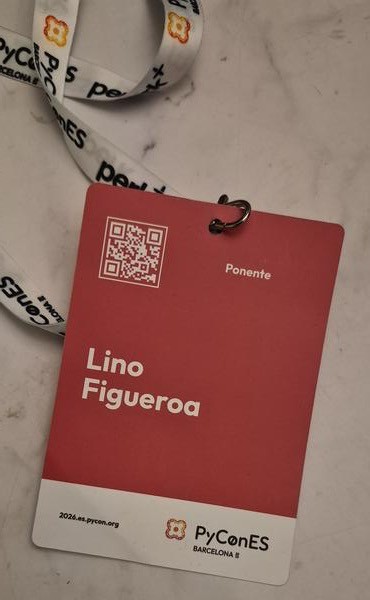
Friday was badge pickup day, and here I have to say something that doesn’t get said enough: everything went smooth as butter. You walk up, give your name, they hand you your badge, and they even smile at you. I wish any corporate login worked half as well.
The volunteers were top-notch all weekend, with a friendliness and an eagerness to help that plenty of paid customer support services can only dream of. And these people don’t get paid. They’re there because they want you to have a good time.
In the afternoon there were all kinds of workshops: from building a synthesizer with Python to calling Rust from Python, with quantum computing and AI agents in between. I didn’t go to any of them. I was wiped out from the eight-hour drive and I had to rehearse those last-minute changes I wasn’t sure about at all. Priorities.
Before locking myself away to rehearse, though, I had lunch with a friend and former coworker I hadn’t seen in four years. We caught up on everything and said good and bad things about a lot of people. Mostly bad, because it’s more fun. No, just kidding: equal parts, because we’re balanced people.
Meal count: 1. I’m counting it because it was a good one.
Right there we drew up a master plan: the next day we were going to loot the sponsors’ booths. T-shirts, stickers, tote bags, whatever there was. We were going to clean them out.
Spoiler alert: we looted next to nothing. We asked permission just to take a sticker. We’re shy and respectful, and we’re both at an age where grabbing three T-shirts at once is a bit embarrassing. The most polite looters in the history of looting.
That night was the dinner for speakers and organizers. Picture a room full of people who don’t know each other at all. For a shy person, that’s facing the final boss of a video game. I got lucky, because a group of folks from Nagarro adopted me, just like that, the way you’d adopt a stray kitten outside the grocery store.
I also met a lot of people from fields very different from mine: people who speak other languages, who were born thousands of kilometers away, and who, above all, work in research. It’s fascinating to see how differently we work, even though we’re all in tech. I talk about microservices and deployments, and the person across from me talks about experiments that take months to produce a result. Which, come to think of it, is how long any change takes to reach production at certain companies. And we both use Python. That’s the glue.
Meal count: 2.
The evening was going great until the reggaeton started. I’m very sorry, but I’m a metal and K-pop guy, yes, both, together and separately. So I did what any mature, responsible person would do: I went back to the hotel to rehearse.
I rehearsed, rehearsed, and rehearsed again. I figure each rehearsal was twenty percent better than the one before, so after ten rehearsals the talk was about six times better than the first version. Which says a lot more about the first version than about the last one. It’s compound interest applied to stage fright.
Saturday morning: sweating like a pig
My talk was at twelve thirty, and I woke up feeling like it was twelve twenty-five. Breakfast at the hotel, a big one, because you fight nerves with carbs. Science doesn’t say that, I do.
Meal count: 3.
I rushed off to the university, a nervous wreck, and rediscovered a fact I knew perfectly well and had completely forgotten: in Barcelona, in November, it’s hot. Properly hot, with that humidity that glues your shirt to your back. I have no excuse, because I lived there for fifteen years, but I’ve spent almost ten in León, where we’re already pulling out scarves in November, and I’ve turned into a mountain creature.
I got to the university sweating like a pig. A pig with a speaker badge, mind you.
There I met up with my partner in looting and went looking for a quiet corner to rehearse a bit more. My nerves were in the red zone: every monitoring dashboard red and the on-call engineer hiding under the desk. So much so that I had to take a sedative. Something mild, the kind that stops the sweating, nothing you’d have to declare at customs.
And to settle the sedative, because you have to do things properly, second breakfast at PyConEs. Like the hobbits.
Meal count: 4.
The talk: uv for people who aren’t uv experts
Twelve thirty, Aula Magna. The room was huge, with paintings of gods and saints looking down at you from the walls; I’m not sure whether they were there to inspire you or to judge your pyproject.toml. And it was packed. I’d come mentally prepared to talk to a handful of friends and someone who’d walked into the wrong room, and there were around a hundred people. Seventeen percent of the conference, by the numbers. In my head, a hundred percent, all of them staring at me.
On the outside, I was the picture of professional calm. On the inside there was a tiny Lino running in circles and screaming. Thank goodness the room volunteers made sure everything ran smoothly: the mic, the screen, the timing, everything in place and no surprises. When someone takes the problems off your plate, you can spend your nerves on what matters, which is not passing out.
What it was about
The talk was called “uv: organize your Python projects as if you knew what you were doing”, and the title says it all. It wasn’t about how to do it like an expert, but about how to do it as if you were one. Because I’m not a uv expert. I’ve just suffered through it. In fact, I introduced myself as a repeat offender: a repeat offender at botching Python project environments, with a record and everything.
It was about my hands-on experience creating new projects with uv and, above all, migrating old projects without dying in the attempt. Those projects where the install instructions boil down to “ask Dave.” The goal was to make setting up your project environments stop being oral tradition.
The slides and the repository with all the demos are on GitHub, in uv-sin-miedo. The PyConEs organizers will publish the video once it’s edited. And if your project still depends on Dave, you know where to start.
The arsenal
I came well prepared. I had a slide deck that I think turned out pretty well and a script on the teleprompter. I wrote the teleprompter app myself last year. Not to brag. Well, okay, a little bit to brag: it’s called Apuntador and it worked like a charm. That’s the nice thing about using your own tools: if they fail, the only one you can blame is that guy you see in the mirror every morning.
The demos were strictly prerecorded. Live demos are Russian roulette: the wifi drops, you forget a command, or the package you’ve been downloading without a hitch for three months decides today’s not the day. So each click showed the next command with its output, captured calmly at home, which is why everything went well without a single error. Just like in staging, where everything always works. Live demos are for the brave, and I’m from Galicia, where the answer to everything is “it depends.”
I also used memes, because some concepts are better explained with a dog in a room on fire than with an architecture diagram. And I slipped in a photo of my four cats, my little velociraptors, to prove that underneath the software architect there’s still a bit of a human being left. Not much, but some.
How it really went
The unvarnished account: nerves, lots of them. A few stumbles, too, although the stumbles were mostly a handful of “uhhhhh"s while I searched my memory for what came next. I’m not perfect, no matter what my cats think: to them I’m the center of the universe, especially when it’s time to fill the food bowl.
The talk landed safely, and then came the Q&A, which was what scared me the most. During the talk, you’re in control; during the questions, the audience is. I think I answered pretty clearly, and when I didn’t know something, I said so. No beating around the bush, no making things up, and none of that very consultant-like technique of confidently answering a different question. Admitting what you don’t know is the best way to get people to believe what you do know.
The question I couldn’t answer
The one that made me think the most was exactly one of those: whether a package’s hash in uv.lock is the same across all platforms, even if that package has to be compiled.
At that moment I had no idea, and for questions like that, no prerecorded demo can save you. I looked into it afterward, and the answer is no. The uv lockfile stores one hash for the package’s source code (the sdist) and a different one for each prebuilt version (each wheel), one per platform. Here’s a real excerpt from the uv.lock of one of the demos, trimmed:
[[package]]
name = "pydantic-core"
version = "2.46.3"
sdist = { url = "https://files.pythonhosted.org/.../pydantic_core-2.46.3.tar.gz", hash = "sha256:41c178f6..." }
wheels = [
    { url = ".../pydantic_core-2.46.3-cp312-cp312-macosx_11_0_arm64.whl", hash = "sha256:af865371..." },
    { url = ".../pydantic_core-2.46.3-cp312-cp312-manylinux_2_17_aarch64.manylinux2014_aarch64.whl", hash = "sha256:75a519da..." },
    # ...and so on for every platform
]
If your machine can’t find a wheel for its platform and has to compile the package, what gets checked is the source code’s hash, because the result of compiling depends on your machine and can’t be written down in advance. So, to whoever asked me: here’s your answer, a week late.
The applause and the “pretty good”
When I finished, applause. I’m not great at accepting compliments: when someone says something nice to me, my brain starts looking for the catch. I think my ears turned red. But I’m truly grateful, and I hope the talk was useful to someone, which is all that matters.
I had to measure the talk’s effectiveness with data. A friend had sent several of his coworkers to see it (I don’t know whether it was a suggestion or an order, and I’d rather not know), so I messaged him on Telegram to ask what they’d told him. His reply, very calm:
They say it was pretty good.
And me, typing in outrage: “What do you mean pretty good, are you kidding me?!”
And the guy corrected himself on the spot: “No, they said very good, the ‘pretty good’ was mine.” I don’t know if he said that out of fear or because the talk really was good. I’ve decided to believe the second option, because that’s what having your own blog is for.
Saturday afternoon: Canarians, an AI that takes years off, and a radar for videos
With the talk done, my body asked for two things: food and socializing, in that order.
Meal count: 5. Yes, I’m counting both Saturday breakfasts.
Over lunch I met a ton of people, and here comes a first-rate sociological discovery: Barcelona has an unbelievable number of Canarians. Canary Islanders, I mean, not canaries. I think I met half the archipelago’s population in a single afternoon. If Tenerife felt a little empty that weekend, now you know where everyone was.
At one of the sponsors’ booths there were some AI apps that try to guess a person’s age from a photo. They got me wrong: they took five years off. At first I took it as a compliment, obviously, five years younger for free, no creams and no eight hours of sleep. Then they tried it on my partner in looting, who’s a year older than me, and they got him wrong too.
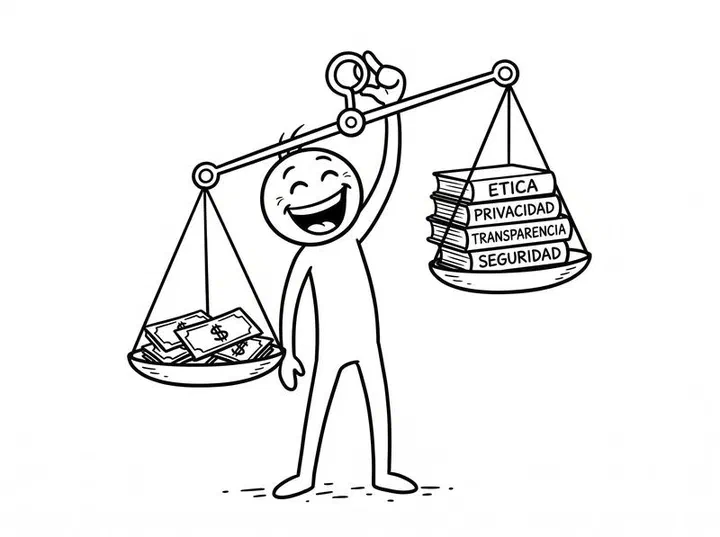
My technical conclusion is less flattering: there weren’t many people our age in the training data. To that model, past a certain age, humanity is an unsolved mystery. And that, which sounds like a joke, is exactly the kind of bias I talked about in my article on ethics in software development. This time it worked in my favor, but it doesn’t always.
At another app at the same booth they showed you several videos and you had to guess which ones were made with AI. Apparently I’m pretty good at spotting them, even the most polished ones. I don’t know if it’s a superpower or the result of too many hours on the internet. I lean toward the latter, but I’m putting it on my résumé as the former, at an advanced level, like the “advanced Excel” on every résumé.
I spent the rest of the afternoon hopping from talk to talk. I remember several about Rust, but not much else, because by then my adrenaline was through the floor and my exhaustion through the roof. Luckily I left with a notebook full of things to look into, which, realistically, is a homework list I assigned myself and that will end up in a drawer with the ones from previous years’ conferences.
And the food, let’s not forget: every two hours there was a break, coffee with food or food with food.
Meal count: I’ve lost track. I admit it.
I skipped dinner on Saturday night. Not because there was nowhere to eat, but because I was as full as a barrel. A happy barrel, mind you.
Sunday: the two talks I’m taking home
Sunday was my day off: no talk pending, no little pills, and no sweating like a pig (well, sweating a bit, because the heat was still there). That day I saw two spectacular, super-useful talks, the kind that deserve full credit.
Clara de Luna and Chemical X
The first was Clara de Luna’s, titled “Ableton, Claude and Python are the Powerpuff Girls of music. What is Chemical X?”. Ableton is a music production app, the kind we in the trade call a DAW, a digital audio workstation, and the talk was about hooking it up to Claude Code and Python so they can give you a hand with production.
You can really tell Clara has experience as an actress and singer. The presentation was flawless and hugely entertaining, the kind where you forget to check your phone, which these days is the highest praise you can give anyone.
She showed Claude generating a complete Ableton project, a lo-fi track, that worked on the first try and, on top of that, sounded good. And to wrap up she sang a song over a backing track generated in Ableton. Ending a tech talk by singing is something I wouldn’t dare do even with two little pills.
It also hit home, because I’ve been wrestling with exactly that problem for a while: I want to connect my audio software to Claude Code so it can help me with production, and I just couldn’t see how. And suddenly, there was someone showing it working.
So, Clara, if you’re reading this, I apologize in advance: I’m going to pester you thoroughly with my questions. Lots of questions. My condolences.
Pablo Galindo and Tachyon
The second was Pablo Galindo’s, one of the CPython core developers, the people who get their hands dirty in the guts of the language. He came to talk about Tachyon, the new sampling profiler that ships with Python 3.15, with a title that was already funny: it said the profiler is faster than your code. Which, knowing my code, isn’t that much of an achievement.
A profiler is a tool that tells you where your program is spending its time. A sampling one, instead of recording everything, peeks in every so often to see what the program is doing, like that boss who walks behind your chair every five minutes, minus the awkward part. The beauty of it is that it’s so unobtrusive you can use it while the program is running for real.
I’d never seen so much complex technical information explained so well in so little time: forty minutes with the kind of content density that usually takes a semester, and you understood all of it. A whole new world opened up for me, the world of performance measurement and of how all those magical things we take for granted work under the hood.
I don’t know what Pablo takes to have that speed and that mental clarity, but I want some. And no, I don’t think it’s the same little pill I took on Saturday.
The lightning talks
I can’t forget the lightning talks on Saturday and Sunday: five minutes, and when time’s up, it’s up, wherever you are. Many of them were packed with humor, and others were calls to get together, to socialize, to build community.
My favorite was the one about Stack-chan, a little open-source robot that, in the talk, they’d programmed with MicroPython. Five minutes, and I already wanted one. My four velociraptors are already licking their chops.
In that format, some people tell you more than others do in an hour. And I, having been on that stage with puppets and with kittens, know how hard it is to nail them.
The closing and the trip home
Sunday went on with more talks and more hallway time, and then came the best part of the weekend: I ran into people who told me the talk had been useful to them. Without me threatening them, for the record. They told me everything was very well explained and easy to follow, and several of them discovered things you can do with uv that they didn’t know about. Nobody, not a single person, told me it was pretty good. I checked.
That’s worth more than all the applause put together, because it means someone is going to show up at work on Monday and be able to tidy up their project a little better.
Then came the last talks and the closing of the conference, with a few tears, emotion, and the best kind of hangover. And not just because of the food. Although also because of the food.
Then, home: another eight hours in the car, eight hundred kilometers to digest everything I’d seen, everything I’d heard, and, above all, everything I’d eaten.
What the conference says about the industry
Joking aside, there are three ideas I’m taking home with me.
The first is that there’s no stopping AI. It’s making its way into our work in every sector, in consulting, in research, in music, in everything. For better or for worse. I saw it in Clara’s talk, at the booth that guessed people’s ages, and in plenty of hallway conversations.
The second is the flip side of the first: there’s a very serious concern about the ethical use of AI, about putting limits on it and finding a way to bring it into everyday life without letting it swallow everything. And I liked that this concern came from people who use the technology every day and know it from the inside, who are the ones best placed to know where the dangers are.
The third is the one I like most: the Python community is a place where people from medicine, research, music, consulting, and whatever else you can think of come together, people who have nothing in common except a shared tool and the itch to tell others what they’ve learned. And that community is still being built by hand, with volunteers, with lightning talks, and with speakers’ dinners, even if they end with reggaeton.
Room for improvement
Since this is a chronicle and not a press release, it’s time for the complaints section. I looked really hard, I promise, and here’s my list of grievances:
- The reggaeton at the dinner.
- The Barcelona heat in November, which isn’t the organizers’ fault, but someone had to say it.
- That they sent me back to León a couple of kilos heavier, and that one is squarely on the catering. At work, we call that a regression in production.
All joking aside, I couldn’t find anything else, because everything went perfectly.
As for my part, what I’d do differently next time is simple: no last-minute changes the week of the talk. Which is exactly the advice I’d give any team before a deploy, and which, like a true professional, I completely ignored.
If you’ve never been to a community conference
I went to Barcelona to teach something and came back with more homework than I took: an audio problem I finally know how to tackle, a whole new world of performance measurement to explore, and a notebook full of things to look into.
So I’ll leave you with a challenge. If you’ve never been to a community conference, go to the next one. And if you have, think about giving your first talk, even if it terrifies you, even if you sweat like a pig, and even if you need a little pill. If a shy Galician, exiled in León and allergic to reggaeton, could do it, so can you.
Heartfelt thanks to the PyConEs organizers and volunteers, who made everything look easy, which is the hardest thing to pull off. And thanks to everyone who came to the talk, including those who were just looking for somewhere with air conditioning.
If you were there and want to tell me what you thought, you’ll find how to reach me at pressanykey.tech. You know what happens to people who say “pretty good.”
Sources and references
Everything in this chronicle that comes with a link. The breakfasts were left out for technical reasons.
- PyConEs 2026 program — PyConEs. Conference dates, talks, and schedule (in Spanish).
- PyConEs 2026 venue — PyConEs. The Historic Building of the University of Barcelona, on the Gran Vía (in Spanish).
- uv-sin-miedo — Press Any Key. Slides and repository with the talk’s demos (in Spanish).
- uv documentation — Astral. The tool the talk was about.
- The uv lockfile — Astral. What
uv.lockstores and what it’s for. - Apuntador — The teleprompter I gave the talk with.
- Ableton Live — Ableton. The music production software from Clara de Luna’s talk.
- Stack-chan — The little open-source robot from my favorite lightning talk (the original project is programmed in JavaScript).
- MicroPython — Python for microcontrollers, which they’d used to program the robot in the talk.
Other languages: Español